
Faculty panel on global education asks a simple question: Where is home?
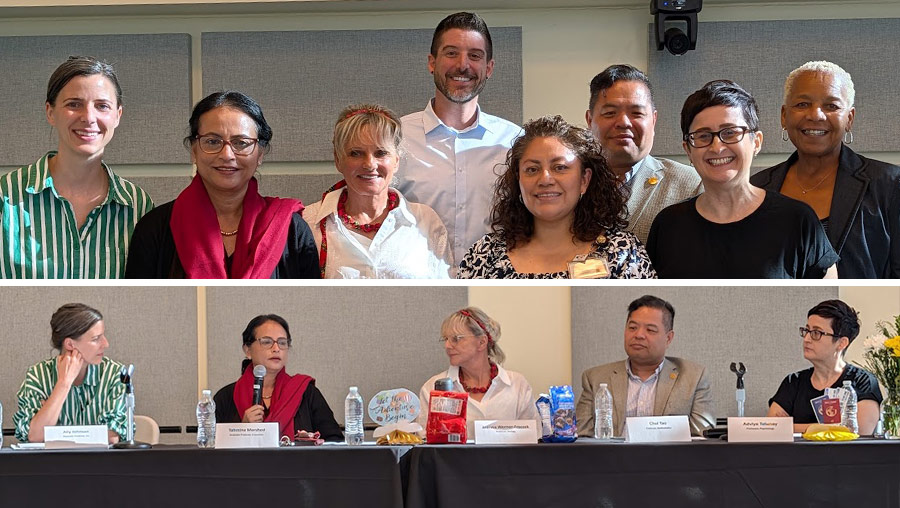
Asked where they call home, the five Moreno Valley College faculty members on the "Beyond Borders" panel held at Moreno Valley College gave answers that ranged from a single U.S. state to two countries at once. One answered, "the whole planet."
Art history professor Ally Johnson, economics professor Tahmina Morshed, biology professor Joanna Werner-Fraczek, math professor Chui Yao and psychology professor Adviye Tolunay spoke at Beyond Borders: Faculty Perspectives on Global Education on Nov. 12, a few days ahead of International Education Week. At a time when immigration is a frequent subject of national debate, the panelists left policy aside and talked about their own lives, including the parts that were hard.
Yao was born in China, spent his childhood in Hong Kong while his family waited to immigrate and arrived in the United States in 1992 at 17, able to say little more than hello in English. He never finished high school. He started at a community college in English as a second language and elementary algebra and worked his way to a doctorate. “Community college really does give me a second chance,” he said, and that is why he came back to teach at one.
Werner-Fraczek grew up in Poland behind the Iron Curtain and came to the United States for a one-year exchange that became a doctorate in plant genetics. At her first lecture at the University of Wisconsin-Madison, she understood nothing, and she studied late into the night with her feet in cold water to stay awake. She also remembers watching her professor kneel in a field to plant potatoes with his students, something no professor in Poland would have done. It taught her, she said, “that we can be who we want to be.”
Tolunay attended kindergarten in Germany and second and third grade in Saudi Arabia before returning to Turkey, and later earned her doctorate at the University of Rhode Island. Those years taught her that “there’s really no one right way of doing things,” a lesson she now builds into her psychology courses. She was also candid that her accent still draws questions about where she is from. “It’s heartbreaking and sometimes it’s frustrating to know that after all this time you still have to prove yourself,” she said.
Morshed, who was born and raised in Bangladesh, first went abroad on exchange programs in Japan and Australia and has since visited more than 40 countries. She brings those places into her economics classes and asks students to share their own experiences “so that we can learn so much from one another.” Johnson, who grew up in Missouri, studied abroad in the south of France as an undergraduate and took a mentor’s advice to choose research that would take her where she wanted to go.
Werner-Fraczek said getting to know individual people from other countries helps people “see that we are all the same. We all need love and we all need each other.” Yao put it more simply: “We survive together, not alone.”
The closing question brought the panel back to where it began. Johnson still names Missouri, though California increasingly feels like home. Morshed said Bangladesh will always be home “because that’s where my mom is, where I can go and hug her.” Werner-Fraczek misses Poland when she is here and misses her life here when she is in Poland. Tolunay, a U.S. citizen, calls the United States home and remains deeply connected to her Turkish roots. Yao, with family in both Sacramento and Riverside, said, “It’s okay to have multiple homes.” In the end, he added, people should see Earth as a shared home and take care of it.
Experiences like these are what RCCD Global Learning and Study Abroad works to open up for students. Werner-Fraczek encouraged students to step outside their comfort zones and reminded them that the first step does not have to be a big one. “You don’t have to go to Hong Kong or New Zealand to experience international travel,” she said. “It can start small.” The benefits also show up in student outcomes. According to event materials, students who study abroad on average earn higher GPAs and have better retention and transfer rates than those who do not.
November is both International Education Week and RCCD’s giving month., a time when the district raises money for its study abroad scholarship fund to help students cover the cost of studying in another country. Consider making a donation.
The panel was presented by RCCD Global Learning and Study Abroad, sponsored by Associated Students Moreno Valley College and organized by professors Tanya Brown and Norma Martinez of the Global Learning and Study Abroad Committee. A recording is available on YouTube.
Students interested in studying abroad can contact the office at (951) 222-8385 or study.abroad@rccd.edu.