
Sampling Among the Spirits: MESA Students Contribute to Redwood Research
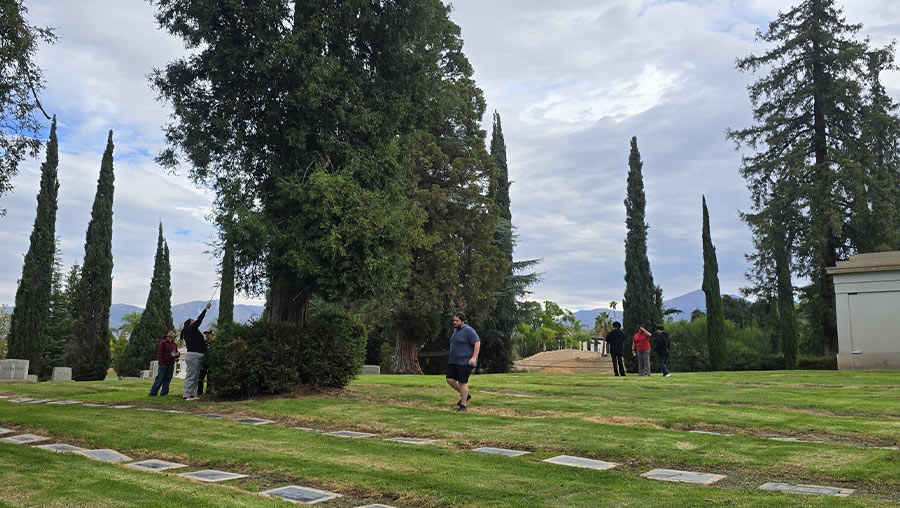
From a historic cemetery to the science lab, Moreno Valley College students take part in a collaborative research effort to understand California’s iconic redwood trees.
In October, Moreno Valley College (MVC) MESA students participated in a scientific research project that took them to an unexpected location: a cemetery. With Halloween approaching, students dubbed the outing “Sampling Among the Spirits,” combining seasonal fun with fieldwork for an ongoing redwood research project.
For the second consecutive year, MVC MESA students contributed to the Tree Environmental Acclimation Monitoring Network (TEAMnet), a collaborative research initiative led by researchers at Cal Poly Humboldt. The project examines how trees respond and adapt to different environmental conditions, generating data that can contribute to a broader understanding of tree resilience in a changing climate.
The research also supports the conservation of California’s redwoods, a priority of Save the Redwoods League, an organization dedicated to protecting and restoring redwood forests through research, conservation and education.
A Research Site Unlike Any Other
The fieldwork took place at Hillside Memorial Park in Redlands, home to six mature redwood trees. Students were struck by the peaceful, park-like setting and the relationship between the trees and the historic gravestones surrounding them. Some headstones date back more than a century, and the trunks of several redwoods have grown around neighboring gravestones.
Working in teams, students collected samples from each tree, documented environmental conditions and recorded field observations. The work required careful sample collection and handling to ensure the materials could be used in the larger research project.
From Fieldwork to Lab Work
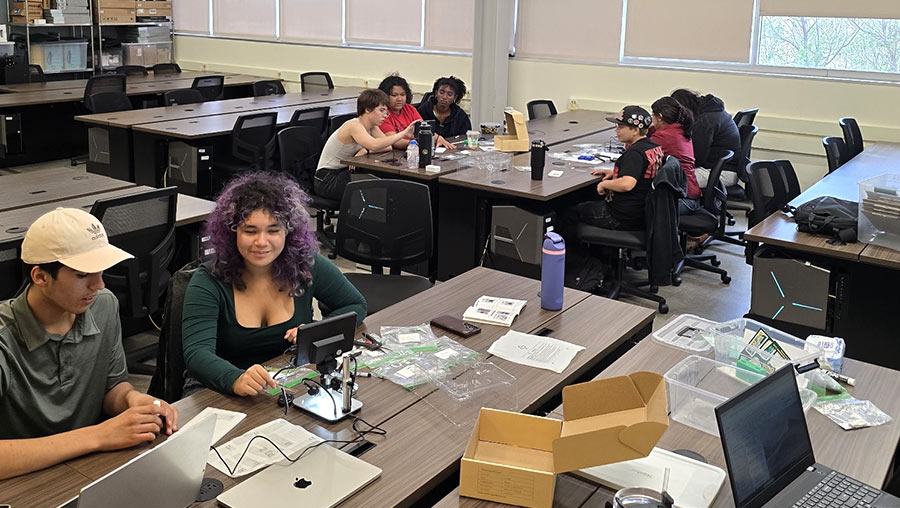
Back at MVC, students moved from fieldwork to laboratory processing, organizing their workstations and preparing the collected samples for analysis.
Following scientific protocols and working together to troubleshoot unfamiliar procedures, students recorded geographic coordinates, documented tree identification and growing conditions, labeled sample photographs and created resin impressions of leaf stomata. These microscopic pores regulate gas exchange and water loss in plants.
The impressions were mounted on microscope slides and prepared for shipment to Cal Poly Humboldt, where researchers will conduct additional measurements and incorporate the findings into their ongoing research.
Throughout the project, students practiced key research skills, including observation, accurate documentation, teamwork and following standardized procedures.
Bringing Research Opportunities to Community College Students
With support from MVC faculty member Blaine Novak-Pilch, students completed the field sampling and laboratory processing, contributing another year of data to the TEAMnet project.
The experience gave students an opportunity to participate in an active research initiative while developing skills that can support their future academic and career goals. Community college students can contribute to scientific investigations and gain hands-on research experience before transferring to a four-year university.
Through the Mathematics, Engineering, Science Achievement (MESA) Program, MVC students access opportunities beyond the classroom, including university research partnerships, scientific projects, professional networks and hands-on experiences in science, technology, engineering and mathematics.
Students interested in research do not have to wait until they transfer to begin contributing to scientific discovery. For these MESA students, the opportunity began with six redwood trees in a historic cemetery.